# Netball Scorer Pro — Full Content
> Complete text of all guides and blog posts published on the Netball Scorer Pro website.
Website: https://www.netballscorerpro.co.uk
App: https://app.netballscorerpro.co.uk
Summary: https://www.netballscorerpro.co.uk/llms.txt
---
## Guides
### Netball Court Layout, Dimensions, and Diagram
URL: https://www.netballscorerpro.co.uk/guides/netball-court-layout-and-dimensions/
Published: 2026-03-12
Updated: 2026-04-18
Tags: rules, court, guide, netball education
Description: A complete guide to the netball court including official dimensions, court markings, zones, goal circle measurements, and a clear court diagram.
Understanding the netball court is essential whether you're a player learning where to go, a coach setting up training, or a scorer keeping track of the game. This guide covers every marking, measurement, and zone on a standard netball court.
Watch our animated guide for a quick visual overview, or read on for the full details.
## Court Dimensions at a Glance
| Measurement | Metric | Imperial |
| ---------------------- | ------- | -------- |
| Court length | 30.5m | 100 ft |
| Court width | 15.25m | 50 ft |
| Each third length | 10.167m | 33.3 ft |
| Goal circle radius | 4.9m | 16 ft |
| Centre circle diameter | 0.9m | 3 ft |
| Goal post height | 3.05m | 10 ft |
| Goal ring diameter | 380mm | 15 in |
These are the official measurements set by the International Netball Federation (INF). Most indoor and outdoor courts follow these dimensions, though some social and junior venues use slightly smaller courts.
---
## The Three Thirds
A netball court is divided into **three equal sections** by two transverse lines running across the width of the court:
### 1. Defending Third
This is your team's goal end — the third where the opposition tries to score against you. Your GK, GD, WD, and C operate here.
### 2. Centre Third
The middle section of the court. This is where centre passes are taken and where most transitional play happens. Five of the seven positions are allowed here: GA, WA, C, WD, and GD.
### 3. Attacking Third
The third where your team tries to score. Your GS, GA, WA, and C operate here.
**Important:** The thirds swap perspective depending on which team you're talking about. Your attacking third is the opposition's defending third.
---
## Court Diagram
GOAL CIRCLE
4.9m radius
ATTACKING THIRD
10.167m long
CENTRE THIRD
0.9m
10.167m long
DEFENDING THIRD
10.167m long
GOAL CIRCLE
4.9m radius
Full court: 30.5m × 15.25m
---
## Key Court Markings
### Sidelines and Baselines
The court boundary is formed by two **sidelines** (the long edges, 30.5m each) and two **baselines** (the short edges, 15.25m each). If the ball crosses any of these lines, it's out of court and possession is awarded to the opposing team.
### Transverse Lines (Third Lines)
Two lines run across the full width of the court, dividing it into the three equal thirds. These are critical because:
- Players must stay in their allowed thirds (or it's offside)
- The ball must be received in each third — it cannot be thrown directly from one end third to the other
- At a centre pass, non-Centre players must stay in their own third until the whistle
### Centre Circle
A small circle (0.9m diameter) in the exact centre of the court. The Centre must have at least one foot inside this circle when taking a centre pass. No other player can enter the centre circle during a centre pass.
### Goal Circles
Semi-circular areas at each end of the court with a **4.9m radius**, measured from the centre of the goal post to the edge of the circle. The goal circle is where all scoring happens:
- Only GS and GA (attacking team) and GK and GD (defending team) can enter
- Goals must be shot from inside the circle
- Penalty shots are taken inside the circle
### Goal Posts
Positioned at the centre of each baseline:
- **Height:** 3.05m (10 ft) from the ground to the top of the ring
- **Ring diameter:** 380mm (15 in) — the ring sits horizontally at the top of the post
- **No backboard** — unlike basketball, netball posts have no backboard
- The post should have padding at the base for player safety
---
## Court Surfaces
Netball is played on several surface types:
| Surface | Common Venue | Notes |
| ------------------------------------- | ------------------- | -------------------------------- |
| Indoor timber/sprung floor | Sports halls | Best for grip and joints |
| Outdoor hard court (asphalt/concrete) | Schools, clubs | Most common in the UK |
| Outdoor synthetic/cushioned | Newer facilities | Good grip, more forgiving |
| Grass | Parks, social games | Uneven surface, casual play only |
The surface must provide adequate grip. Players should wear appropriate footwear — indoor shoes for timber floors and outdoor netball trainers for hard courts.
---
## Court Zones by Position
Understanding which zones each position can enter is fundamental to netball:
| Position | Defending Third | Centre Third | Attacking Third | Defending Goal Circle | Attacking Goal Circle |
| -------- | --------------- | ------------ | --------------- | --------------------- | --------------------- |
| **GK** | Yes | No | No | Yes | No |
| **GD** | Yes | Yes | No | Yes | No |
| **WD** | Yes | Yes | No | No | No |
| **C** | Yes | Yes | Yes | No | No |
| **WA** | No | Yes | Yes | No | No |
| **GA** | No | Yes | Yes | No | Yes |
| **GS** | No | No | Yes | No | Yes |
For a full explanation of each position, see our [netball positions guide](/blog/netball-positions-explained/).
---
## Setting Up a Court
If you're marking out a court for training or a social game, here's what you need:
### Equipment
- Measuring tape (at least 30m)
- Marking cones, chalk, or line paint
- Two goal posts (3.05m height)
### Steps
1. Mark the baseline: 15.25m wide
2. From each corner, measure 30.5m along the sideline
3. Mark the second baseline parallel to the first
4. Divide the length into three equal sections (10.167m each) and mark the two transverse lines
5. Find the centre point and mark the centre circle (0.9m diameter)
6. At each baseline centre point, position the goal post and mark the goal circle (4.9m radius semi-circle)
### Quick Tip for Training
If you don't have a full court, you can work with a single third for shooting practice or use cones to mark out zones for drills. Many [netball drills](/guides/netball-drills-for-training/) only need part of a court.
---
## Common Court-Related Rules
- **Out of court:** The ball is out when it touches the ground outside the court lines, or when a player holding the ball touches or lands outside the lines
- **Over a third:** The ball must be touched in each third — you can't throw it from one end third directly into the other end third
- **Offside:** A player entering a court area they're not allowed in. Results in a free pass to the opposition
- **Centre pass positioning:** Before the whistle, all non-Centre players must be entirely within their allowed third (not in the centre third)
---
## Frequently Asked Questions
### Is the goal circle a full circle?
No. It's a **semi-circle** — the straight edge is the baseline. The curved line extends 4.9m from the goal post into the court.
### Can players stand on the lines?
The transverse lines and centre circle line are considered part of the area **in front of** the line (towards the centre of the court). A player standing on a transverse line is in the centre third. For sidelines and baselines, standing on the line is out of court.
### What if there's no centre circle marked?
In informal games, the Centre just stands in the approximate centre. In competitive matches, the circle must be marked.
### How much space do I need for a full court?
You need at least **33m × 18m** to allow a small run-off area around the court. Indoor venues should have a minimum of 3.05m clearance above the court.
---
_Measurements in this guide follow International Netball Federation (INF) standards. Some junior or social competitions may use modified court sizes._
---
_Scoring a game on one of these courts? Try [Netball Scorer Pro](https://app.netballscorerpro.co.uk) — a free app that tracks scores, centre passes, and quarter times automatically. Works offline on any device._
---
### Netball Drills for Training: Improve Your Game
URL: https://www.netballscorerpro.co.uk/guides/netball-drills-for-training/
Published: 2026-03-12
Tags: skills, drills, coaching, guide, netball education
Description: Practical netball drills for passing, shooting, footwork, defending, and fitness. Suitable for coaches, players, and teams at all levels.
Netball drills are structured training exercises designed to improve specific skills needed on court. This guide covers 15 practical netball drills for passing, shooting, footwork, defending, and fitness — suitable for coaches, players, and teams at all levels.
Each drill includes the setup, how to run it, what skill it develops, and progressions to increase difficulty.
---
## Netball Passing Drills
### 1. Triangle Passing
**Players needed:** 3
**Equipment:** 1 ball
**Area:** Small square, about 5m apart
Three players form a triangle. Pass the ball around the triangle using a specified pass type (chest, bounce, shoulder). After a set time, switch direction and switch pass type.
**Progression:**
- Increase speed
- Add a defender in the middle trying to intercept
- Require players to move to a new position after each pass (dynamic triangle)
**Develops:** Passing accuracy, catching under pressure, quick release
---
### 2. Two-Line Passing
**Players needed:** 6+ (split into two lines facing each other)
**Equipment:** 1–2 balls
**Area:** 8–10m between lines
Two lines of players face each other. The first player passes to the person opposite, then runs to join the back of the opposite line. The receiver does the same.
**Progression:**
- Use different pass types each round
- Add a second ball so two passes are happening simultaneously
- Make the receiving player drive forward to meet the pass before catching
**Develops:** Passing on the move, timing, fitness
---
### 3. Pressure Passing Circle
**Players needed:** 5–6
**Equipment:** 1 ball
**Area:** Circle of about 6m diameter
Players stand in a circle with one or two defenders in the middle. The outside players must pass the ball across the circle without the defenders intercepting. If a defender touches the ball, they swap with the passer.
**Progression:**
- Add a 3-second time limit for each pass
- Require a specific pass type
- Reduce the circle size
**Develops:** Quick decision-making, varied pass selection, vision
For a full breakdown of pass types to use in these drills, see our [netball passes guide](/guides/types-of-netball-passes/).
---
## Netball Shooting Drills
### 4. Spot Shooting
**Players needed:** 1–2
**Equipment:** 1 ball, 1 goal post
**Area:** Goal circle
The shooter stands at a marked spot in the goal circle and takes 10 shots. Record how many go in. Move to a different spot and repeat. Cover at least 5 positions: close to the post, left and right sides, edge of the circle, and centre.
**Progression:**
- Add a time limit (shoot within 3 seconds of receiving)
- Have a feeder pass the ball from outside the circle before each shot
- Add a passive defender who stands nearby (no blocking, just presence)
**Develops:** Shooting accuracy, consistency from different angles
---
### 5. Pressure Shooting
**Players needed:** 3 (shooter, feeder, defender)
**Equipment:** 1 ball, 1 goal post
**Area:** Goal circle
The feeder stands outside the circle and passes to the shooter inside. A defender actively tries to block the shot (respecting the 3-foot rule). The shooter must catch, set, and shoot under pressure.
**Progression:**
- Add a second defender
- Require the shooter to move and create space before receiving
- Set a target (e.g., score 7 out of 10)
**Develops:** Shooting under pressure, composure, footwork in the circle
---
### 6. Rebound and Shoot
**Players needed:** 2 (shooter and rebounder)
**Equipment:** 1 ball, 1 goal post
**Area:** Goal circle
The shooter takes a shot. If it misses, the rebounder catches it and passes it straight back. The shooter immediately repositions and shoots again. Continuous for 60 seconds — count successful goals.
**Develops:** Shooting recovery, positioning after a miss, fitness
---
## Netball Footwork Drills
### 7. Landing Practice
**Players needed:** 2
**Equipment:** 1 ball
**Area:** Any flat space
One player feeds the ball to the other, who must catch it while landing correctly — establishing a landing foot and pivoting without stepping. The feeder varies the pass height, speed, and angle to challenge different landing situations.
**Progression:**
- Catch while running forward
- Catch while changing direction
- Add a requirement to pivot and pass within 2 seconds of landing
**Develops:** Correct landing technique, footwork rule compliance, balance
---
### 8. Cone Agility with Ball
**Players needed:** 1
**Equipment:** 1 ball, 5–6 cones
**Area:** 10m × 5m
Set cones in a zigzag pattern. The player runs to each cone, stops with correct footwork (landing foot planted), pivots, and passes to a wall or partner before moving to the next cone.
**Progression:**
- Increase speed
- Reduce the gap between cones
- Add a defender following behind
**Develops:** Agility, footwork under fatigue, quick pivots
---
### 9. Driving and Stopping
**Players needed:** 2
**Equipment:** 1 ball
**Area:** One third of the court
One player drives (runs) towards the other, receives a pass at full speed, and must stop legally (one-two landing or balanced jump stop). They then pivot and pass back. Repeat 10 times, then swap.
**Develops:** Controlled stopping at speed, landing foot discipline, match-realistic footwork
---
## Netball Defending Drills
### 10. Shadow Defending
**Players needed:** 2
**Equipment:** None
**Area:** One third of the court
One player (attacker) moves freely around the third — changing direction, speed, and using dodges. The defender mirrors their movement, staying within arm's reach without making contact.
**Progression:**
- Add a ball — the attacker receives passes from a third player while the defender tries to stay close
- Set 30-second rounds and count how many times the defender stays within marking distance
**Develops:** Defensive positioning, reading body language, agility
---
### 11. Intercept Drill
**Players needed:** 3 (two passers, one defender)
**Equipment:** 1 ball
**Area:** 5–8m channel
Two passers stand about 8m apart. A defender stands between them. The passers try to complete passes while the defender reads the play and intercepts. Rotate after each interception or after 60 seconds.
**Progression:**
- Widen the channel to make it harder for the defender
- Allow passers to use any pass type
- Add a second defender
**Develops:** Anticipation, reading the ball, intercept timing
---
### 12. 3-Foot Challenge
**Players needed:** 3 (ball carrier, defender, observer)
**Equipment:** 1 ball
**Area:** Small space
The ball carrier holds the ball. The defender must position themselves exactly 0.9m (3 feet) away — close enough to pressure but without committing obstruction. The observer checks the distance and calls "too close" or "good".
**Progression:**
- The ball carrier pivots and the defender must adjust position
- Add a passing option so the defender must react when the ball is released
- Time how long the defender can maintain correct distance while the attacker pivots
**Develops:** Understanding the 3-foot rule, defensive discipline, spatial awareness
---
## Netball Fitness Drills
### 13. Thirds Shuttle Run
**Players needed:** Any number
**Equipment:** Cones or court lines
**Area:** Full court
Players start on the baseline. Sprint to the first third line and back, then to the centre line and back, then to the far third line and back, then to the far baseline and back. Rest, then repeat.
**Develops:** Speed, endurance, acceleration and deceleration (match-realistic movement)
---
### 14. Ball Relay
**Players needed:** 6+ (two teams)
**Equipment:** 1 ball per team
**Area:** Full court
Two teams line up along the court. The ball must be passed from one end to the other and back. The team that completes the relay first wins. Players must use legal passes and correct footwork.
**Progression:**
- Require a specific pass type
- Players must move to a new position after passing
- Add a "must bounce pass through the centre third" rule
**Develops:** Passing speed, teamwork, competitive intensity
---
### 15. Position-Specific Fitness Circuit
**Players needed:** 7+
**Equipment:** Cones, balls, goal post
**Area:** Full court
Set up stations around the court that match what each position does in a game:
- **GS/GA station:** Continuous shooting for 2 minutes
- **WA/C station:** Repeated drives into the centre third, receive and pass
- **WD/GD station:** Shadow defending with direction changes
- **GK station:** Rebounding drills — jump, catch, land, pass out
Players rotate through all stations. This builds fitness while reinforcing position-specific skills.
**Develops:** Match fitness, position-specific conditioning
---
## Planning a Training Session
A balanced training session typically follows this structure:
| Phase | Duration | Focus |
| ----------------- | -------- | ---------------------------------------------- |
| Warm-up | 10 min | Light jogging, dynamic stretches, easy passing |
| Skill drills | 20 min | Passing, footwork, or shooting focus |
| Game-based drills | 15 min | Defending, small-sided games, match scenarios |
| Fitness | 10 min | Shuttles, relays, or circuit |
| Cool-down | 5 min | Stretching, review |
### Tips for Coaches
- **Vary the drills** each session to keep players engaged
- **Progress gradually** — start simple and add complexity
- **Make it competitive** — adding scores or time limits increases intensity
- **Keep queues short** — if players are standing around waiting, split into smaller groups
- **Link drills to the game** — explain why each drill matters in a match situation
---
## Quick Drill Reference
| Drill | Players | Focus Area | Intensity |
| ----------------------- | ------- | ----------------------- | ----------- |
| Triangle Passing | 3 | Passing | Low–Medium |
| Two-Line Passing | 6+ | Passing, fitness | Medium |
| Pressure Passing Circle | 5–6 | Decision-making | Medium–High |
| Spot Shooting | 1–2 | Shooting accuracy | Low |
| Pressure Shooting | 3 | Shooting under pressure | Medium–High |
| Rebound and Shoot | 2 | Shooting recovery | High |
| Landing Practice | 2 | Footwork | Low |
| Cone Agility | 1 | Agility, footwork | Medium |
| Driving and Stopping | 2 | Footwork at speed | Medium–High |
| Shadow Defending | 2 | Defensive movement | Medium |
| Intercept Drill | 3 | Anticipation | Medium–High |
| 3-Foot Challenge | 3 | Defensive discipline | Low |
| Thirds Shuttle Run | Any | Speed, endurance | High |
| Ball Relay | 6+ | Passing speed, teamwork | High |
| Position Circuit | 7+ | Match fitness | High |
---
## Frequently Asked Questions
### What are good netball drills for beginners?
Triangle Passing, Landing Practice, and Spot Shooting are ideal for beginners. They focus on the core skills (passing, footwork, shooting) with simple setups and low player counts. Start with these before moving to more complex drills.
### How long should a netball training session be?
A typical session runs 60 minutes: 10 minutes warm-up, 20 minutes skill drills, 15 minutes game-based drills, 10 minutes fitness, and 5 minutes cool-down. Junior sessions can be shorter (40–45 minutes).
### How do I make netball drills more challenging?
Most drills can be progressed by adding time pressure, reducing space, introducing defenders, requiring specific pass types, or increasing speed. The progressions listed under each drill above give specific examples.
### Can I practise netball drills on my own?
Some drills work solo — Spot Shooting (with a post), Cone Agility with Ball (passing against a wall), and Thirds Shuttle Runs all require only one player. Most passing and defending drills need at least 2–3 players.
---
_Good training translates to better match performance. Focus on the basics — passing, footwork, and positioning — and the rest follows._
---
_Running a training match? Use [Netball Scorer Pro](https://app.netballscorerpro.co.uk) to score practice games and help new scorers learn before match day. Free, works offline, no account needed._
---
### Netball Rules: A Complete Guide for Beginners
URL: https://www.netballscorerpro.co.uk/guides/netball-rules-complete-guide/
Published: 2026-03-12
Tags: rules, beginner, guide, netball education
Description: Learn the rules of netball including scoring, positions, passing, footwork, contact, and penalties. A complete guide for beginners.
The rules of netball govern a fast, non-contact team sport played by two teams of seven players on a rectangular court. Each team scores by shooting a ball through a raised ring, with strict rules on player movement, ball handling, and defending. Whether you're a new player, parent on the sideline, or volunteer scorer, this guide covers every netball rule you need to know.
## The Basics
Netball is a fast, skilful team sport played by two teams of seven players. The objective is simple: score more goals than the opposition by shooting the ball through a raised ring (the goal post) at your attacking end.
**Key facts:**
- 7 players per team on court
- 4 quarters of 15 minutes (senior) or 10–12 minutes (junior)
- Every goal is worth 1 point
- Only two positions can score: Goal Shooter (GS) and Goal Attack (GA)
- Goals must be scored from inside the goal circle
---
## The Court
A netball court is 30.5m long and 15.25m wide, divided into **three equal thirds**:
1. **Defending third** — your team's goal end
2. **Centre third** — the middle section
3. **Attacking third** — the opponent's goal end
Each end has a **goal circle** — a semi-circle with a 4.9m radius around the goal post. This is the only area where goals can be scored.
There's also a **centre circle** in the middle of the court where centre passes are taken.
For a detailed breakdown of court measurements and layout — including an animated video walkthrough — see our [netball court guide](/guides/netball-court-layout-and-dimensions/).
---
## Positions and Where They Can Go
Each player wears a bib showing their position. Every position is restricted to certain areas of the court:
| Position | Abbreviation | Allowed Areas |
| ------------ | ------------ | -------------------------------------------- |
| Goal Shooter | GS | Attacking third + goal circle |
| Goal Attack | GA | Attacking third + centre third + goal circle |
| Wing Attack | WA | Attacking third + centre third |
| Centre | C | All three thirds (not goal circles) |
| Wing Defence | WD | Defending third + centre third |
| Goal Defence | GD | Defending third + centre third + goal circle |
| Goal Keeper | GK | Defending third + goal circle |
**Offside rule:** If a player enters an area they're not allowed in, the umpire awards a free pass to the opposition.
For more detail on each role, read our [netball positions guide](/blog/netball-positions-explained/).
---
## Starting Play: The Centre Pass
The game starts — and restarts after every goal — with a **centre pass**:
1. The Centre (C) stands inside the centre circle with the ball
2. All other players must be in their own areas (not the centre third) until the whistle
3. The umpire blows the whistle and the Centre passes the ball
4. The ball must be caught by someone in or landing in the centre third
**Centre pass alternation:** Centre passes alternate between teams throughout the match, regardless of which team scores. The team that takes the first centre pass is decided by coin toss. Most leagues use the [odds and evens system](/guides/netball-center-pass-rules-explained/) to track which team's turn it is.
---
## Scoring Rules
### Who can score?
Only **GS** and **GA** can shoot for goal.
### Where can they score from?
Goals must be scored from **inside the goal circle**. If a player shoots from outside the circle, the goal does not count.
### How much is a goal worth?
Every goal is worth **1 point**, regardless of where the shot was taken within the circle or how it was scored.
### What counts as a goal?
The ball must pass completely through the ring from above. If the ball bounces on the ring and drops through, it counts. If it bounces back out, it doesn't.
For a deeper look at how scoring works, see our [guide to scoring a netball game](/guides/how-to-score-a-netball-game/).
---
## Netball Ball Handling Rules
### The 3-Second Rule
Once a player catches the ball, they have **3 seconds** to pass or shoot. If they hold it longer, the umpire awards a free pass to the opposition. This keeps the game moving quickly.
### Footwork Rule
When a player catches the ball:
- The foot that lands first (or is already on the ground) becomes the **landing foot**
- The landing foot **cannot be moved** once grounded
- The player can pivot on the landing foot, step with the other foot, and lean — but must not drag, slide, or lift the landing foot
If a player catches the ball with both feet grounded simultaneously, either foot can be the landing foot, but once one is lifted, the other becomes fixed.
**Common mistake:** New players often shuffle or take extra steps after catching the ball. This is called "stepping" or "footwork" and results in a free pass.
### Passing
The ball must be thrown or released — it cannot be handed directly to another player. There's no restriction on the type of pass used: chest pass, bounce pass, shoulder pass, and lob are all legal.
The ball must also be caught or touched in each third of the court. It cannot be thrown directly from one end third to the other without being touched in the centre third (this is called "over a third").
Learn about all the different pass types in our [types of netball passes guide](/guides/types-of-netball-passes/).
---
## Contact and Obstruction Rules
Netball is a **non-contact sport**. Two key rules enforce this:
### Contact Rule
Players cannot push, bump, trip, hold, or lean on an opponent. Any physical contact that interferes with an opponent's play results in a **penalty pass** (or penalty pass/shot if it occurs in the goal circle).
The penalised player must stand beside the person taking the pass and cannot move until the ball is released.
### Obstruction Rule (3-Foot Rule)
When defending, a player must be at least **0.9 metres (3 feet)** from the player with the ball. This distance is measured from the landing foot of the ball carrier to the nearest foot of the defender.
If a defender is closer than 0.9m when they attempt to block or intercept, the umpire calls **obstruction** and awards a penalty pass.
**What defenders can do:**
- Stand 0.9m or more away and extend arms to block
- Intercept a pass while it's in flight (the 3-foot rule only applies when defending the player holding the ball)
- Mark space rather than the player directly
---
## Penalties and Free Passes
There are two types of sanctions in netball:
### Free Pass
Awarded for minor infringements:
- Offside
- Breaking the footwork rule
- Held ball (3-second rule)
- Over a third
- Breaking at centre pass (moving into centre third before the whistle)
The free pass is taken from where the infringement occurred. Any player allowed in that area can take the pass.
### Penalty Pass (or Penalty Pass/Shot)
Awarded for contact or obstruction:
- The offending player must stand beside the taker and not move until the ball is released
- If the penalty is in the goal circle, the taker can choose to pass or shoot
- If outside the goal circle, the taker must pass
---
## Substitutions
Teams can make substitutions:
- During the interval between quarters
- During injury time
- Players can swap positions with each other at these breaks
There's no limit on the number of substitutions, but changes can only be made during stoppages, not during live play.
---
## Timing
### Quarter Length
| Level | Quarter Length |
| -------------------- | -------------- |
| Senior/International | 15 minutes |
| Junior (under 14+) | 10–12 minutes |
| Social/modified | Varies |
### Intervals
- **Between quarters 1–2 and 3–4:** 2 minutes (junior games may be shorter)
- **Half time (between quarters 2–3):** 5 minutes (junior games may be shorter)
### Extra Time
If the game is drawn in a knockout competition, extra time may be played. The format varies by competition but typically involves two 7-minute halves.
---
## Common Rule Mistakes
Here are the most common mistakes new players and spectators misunderstand:
1. **Centre pass not received** — if the ball from a centre pass isn't received in the centre third (crosses a transverse line untouched), the opposition is awarded a free pass for "over a third"
2. **Toss-up** — if two opposing players catch the ball simultaneously, the umpire holds a toss-up between them
3. **Held ball includes shooting** — the 3-second rule applies to shooting attempts too. A GS standing in the circle holding the ball must shoot or pass within 3 seconds
4. **You can't bounce the ball** — unlike basketball, players cannot dribble or bounce the ball to themselves
---
## Quick Reference Summary
| Rule | Detail |
| ------------------ | --------------------------------- |
| Players per team | 7 on court |
| Quarters | 4 |
| Goal value | 1 point |
| Who can score | GS and GA only |
| Scoring area | Inside goal circle only |
| Holding time | 3 seconds maximum |
| Defending distance | 0.9m (3 feet) minimum |
| Contact | Not allowed |
| Substitutions | At quarter breaks and injury time |
---
## Frequently Asked Questions
### What are the basic rules of netball?
Netball is played by two teams of 7 players. Goals are scored by shooting through a raised ring from inside the goal circle. Only GS and GA can score. Players cannot run with the ball, must pass within 3 seconds, and cannot move their landing foot. Defenders must stay 0.9m (3 feet) from the ball carrier. The team with the most goals after 4 quarters wins.
### How many players are on a netball team?
Each team has 7 players on court at any time, drawn from a squad of up to 12. The 7 positions are GS, GA, WA, C, WD, GD, and GK.
### Can you dribble in netball?
No. Unlike basketball, dribbling and bouncing the ball to yourself are not allowed in netball. Players must pass the ball to a teammate. Bounce passes (where the ball bounces to another player) are legal.
### What happens if you hold the ball for more than 3 seconds?
The umpire awards a free pass to the opposing team from the spot where the infringement occurred. The 3-second rule applies from the moment the player catches the ball.
### What is the 3-foot rule in netball?
When defending a player who is holding the ball, the defender must be at least 0.9 metres (3 feet) away, measured from the ball carrier's landing foot. Standing closer is called obstruction and results in a penalty pass.
---
_This guide covers standard netball rules suitable for most leagues. For official international rules, consult the International Netball Federation (INF) rulebook. Junior and social leagues may apply modified rules._
---
_Want to put these rules into practice? Try [Netball Scorer Pro](https://app.netballscorerpro.co.uk) — a free app for tracking netball scores, center passes, and quarter times. Works offline on any device, no account needed._
---
### Types of Netball Passes: A Complete Guide
URL: https://www.netballscorerpro.co.uk/guides/types-of-netball-passes/
Published: 2026-03-12
Tags: skills, passing, guide, netball education
Description: Learn every type of netball pass including chest, bounce, shoulder, lob, and overhead. When to use each, technique tips, and common mistakes.
A netball pass is how players move the ball up the court — since running with the ball and dribbling are not allowed, every movement relies on accurate, well-timed passes. There are six main types of netball pass, each suited to different game situations. Mastering them gives you options whether you're feeding the circle, breaking through defence, or moving the ball out from your own end.
## Passing Rules in Netball
Before diving into the types of passes, here are the key rules:
- You have **3 seconds** to pass or shoot after receiving the ball
- The ball must be thrown or released — you can't hand it directly to a teammate
- The ball must be **received in each third** of the court (no "over a third" passes)
- There's no restriction on which type of pass you use
- You cannot pass to yourself (no throwing the ball up and catching it)
---
## The Six Main Types of Netball Pass
### 1. Chest Pass
The most common pass in netball and the first one every player learns.
**Technique:**
- Hold the ball with both hands at chest height, fingers spread behind the ball
- Elbows tucked in at your sides
- Step forward with one foot as you push the ball out from your chest
- Extend your arms fully, flicking your wrists to add speed
- Follow through with fingers pointing towards your target
**When to use it:**
- Short to medium distances (up to about 5m)
- When you have a clear line to your teammate
- Quick passes in tight spaces
- Restarting play from a free pass
**Strengths:** Accurate, quick release, easy to control
**Weaknesses:** Easy for defenders to read, limited range
---
### 2. Bounce Pass
The ball is directed towards the ground so it bounces up to the receiver. Useful for getting past defenders.
**Technique:**
- Start with the ball at waist or chest height
- Step forward and push the ball towards the ground
- Aim for the ball to bounce roughly two-thirds of the way between you and the receiver
- The ball should bounce up to the receiver's waist or chest height
- Use backspin to control the bounce
**When to use it:**
- Getting past a tall defender who has their arms up
- Feeding the ball into the goal circle to shooters
- Short distances where a direct pass is blocked
- When the defender is marking your chest pass line
**Strengths:** Gets under a defender's arms, harder to intercept
**Weaknesses:** Slower than a direct pass, can be affected by wet courts, requires good judgement of bounce angle
---
### 3. Shoulder Pass
A one-handed, powerful pass thrown from beside the shoulder. The go-to pass for longer distances.
**Technique:**
- Hold the ball in your throwing hand, supported by the other hand
- Bring the ball up beside your ear/shoulder
- Step forward with the opposite foot
- Drive your throwing arm forward, releasing the ball with a strong wrist flick
- Follow through with your arm pointing at the target
**When to use it:**
- Long passes across a third or down the court
- Fast breaks where speed is essential
- Passing over the heads of shorter players
- When you need power and distance
**Strengths:** Long range, fast, powerful
**Weaknesses:** One-handed so slightly less accurate, takes longer to set up, easier for defenders to read the direction
---
### 4. Overhead Pass (Two-Handed Shoulder Pass)
A two-handed pass released from above the head. Combines power with accuracy.
**Technique:**
- Hold the ball with both hands above and slightly behind your head
- Elbows point forward, not out to the sides
- Step forward and throw the ball by extending both arms
- Release the ball at the highest point
- Flick both wrists for speed and follow through
**When to use it:**
- Medium to long distances
- Passing over a defender who is marking your chest
- Getting height on a pass into the goal circle
- When defenders are closing in and you need to release above them
**Strengths:** Hard to intercept due to height, good range, two-handed accuracy
**Weaknesses:** Slower release than a chest pass, can telegraph direction if not disguised
---
### 5. Lob Pass
A high, arcing pass that travels over defenders and drops down to the receiver.
**Technique:**
- Can be thrown one-handed (like a shoulder pass with more height) or two-handed
- Aim to get height on the ball so it arcs over the defender
- The ball should drop just in front of or directly to the receiver
- Time the pass so the receiver can move onto it
- Adjust the arc based on the distance — higher for shorter distances, flatter for longer
**When to use it:**
- Passing over a tall defender to a shooter in the circle
- When the direct passing lane is completely blocked
- Feeding the goal circle from the edge
- WA or C feeding GS or GA who are closely marked
**Strengths:** Difficult for defenders to intercept if well-placed, effective into the circle
**Weaknesses:** Slow — gives defenders time to react, requires precise judgement of arc and distance, easier to misjudge in windy conditions
---
### 6. Flick Pass (or Quick Pass)
A short, sharp pass made with a quick flick of the wrist. Used in tight situations.
**Technique:**
- Hold the ball in one or both hands
- Use a quick wrist snap to redirect the ball
- Minimal backswing — the power comes from the wrist
- Can be made from various body positions
**When to use it:**
- Quick transfers in traffic
- Redirecting the ball in the centre third when there's no time to set up
- When you're closely marked and need to release immediately
- Passing out of a congested area
**Strengths:** Very fast release, hard to anticipate
**Weaknesses:** Limited range, less accuracy over distance, requires good wrist strength
---
## Choosing the Right Pass
| Situation | Best Pass | Why |
| ------------------------------- | ------------------ | -------------------------- |
| Short, clear line to teammate | Chest pass | Quick, accurate, reliable |
| Defender's arms are up in front | Bounce pass | Goes under the block |
| Long distance down the court | Shoulder pass | Power and range |
| Feeding into the goal circle | Lob or bounce pass | Gets past circle defenders |
| Defender blocking your chest | Overhead pass | Releases above the block |
| Tight space, no time | Flick pass | Fastest release |
| Over a tall defender | Lob pass | Clears the height |
---
## Common Passing Mistakes
### 1. Flat, slow passes
Passes without enough speed are easy to intercept. Always follow through with your wrists to add zip to the ball.
### 2. Telegraphing the pass
Looking directly at your target before passing tells the defender exactly where the ball is going. Use your peripheral vision and try to disguise your passes.
### 3. Passing to where the player is
Pass to where your teammate **will be**, not where they are now. Netball players are constantly moving — lead them with your pass.
### 4. One-pass thinking
Don't always go for the obvious pass. If the direct option is covered, look for a different passing angle or pass type.
### 5. Stepping before passing
Remember the footwork rule — you can't move your landing foot. Many turnovers come from players stepping before releasing the ball.
---
## Passing Drills to Practise
### Triangle Passing
Three players stand in a triangle, about 4–5m apart. Pass the ball around the triangle using different pass types each round (chest, bounce, shoulder). Increase speed as you warm up.
### Two-on-One Keepaway
Two attackers try to maintain possession against one defender in a small area. Forces quick decision-making and varied pass types.
### Long-Short-Long
Three players in a line. The middle player receives a long pass, turns, and delivers a short pass — then receives a short pass and delivers a long one. Practises transitioning between pass types.
### Circle Feeding
A feeder stands outside the goal circle with a defender between them and a shooter inside. The feeder must find ways to get the ball to the shooter using different passes. Rotate roles.
For more training ideas, see our [netball drills guide](/guides/netball-drills-for-training/).
---
## Passing in Game Situations
### At Centre Pass
The centre pass is typically a short, quick pass — usually a chest pass or a flat shoulder pass. The key is timing: the receiver drives into the centre third and the Centre releases the ball as they arrive. Read more about [centre pass rules](/guides/netball-center-pass-rules-explained/).
### In the Attacking Third
Passes into the goal circle need precision. Lobs and bounce passes are common because they help get the ball past circle defenders. The WA and GA often act as feeders, using quick passes to find the shooters.
### In Defence
When winning the ball back, the first pass out of defence is crucial. A strong shoulder pass down the sideline or a quick chest pass to the Centre can start a fast break before the opposition resets.
---
## Tips for Better Passing
1. **Practise with both hands** — being able to shoulder pass with either arm makes you much harder to defend
2. **Strengthen your wrists** — wrist strength directly affects pass speed and control
3. **Communicate** — call your teammate's name or use a visual signal before passing
4. **Vary your passes** — if you always use the same pass, defenders will read you
5. **Watch the defender** — their body position tells you which pass will work best
---
## Frequently Asked Questions
### How many types of passes are there in netball?
There are six main types of netball pass: chest pass, bounce pass, shoulder pass, overhead pass, lob pass, and flick pass. The chest pass is the most common, while the shoulder pass is used for longer distances.
### What is the best pass in netball?
There is no single best pass — it depends on the situation. The chest pass is the most reliable for short distances. The bounce pass is effective against tall defenders. The shoulder pass covers the most distance. Good players use a mix of all pass types.
### Can you bounce the ball in netball?
You cannot bounce the ball to yourself (that's a rule violation), but bounce passes to a teammate are legal and commonly used. Bounce passes are especially effective for feeding the ball into the goal circle past defenders.
### What is the hardest pass in netball?
The lob pass is generally considered the most difficult because it requires precise judgement of arc, distance, and timing. If misjudged, it gives defenders time to intercept. The shoulder pass with the non-dominant hand is also challenging for many players.
---
_Passing is a skill that improves with practice. The more passes you make in training, the more instinctive your choices become in games._
---
_Tracking goals from all those great passes? Try [Netball Scorer Pro](https://app.netballscorerpro.co.uk) — a free app for scoring netball games with automatic centre pass tracking. Works offline on any device._
---
### What Is Netball? A Beginner's Guide to the Sport
URL: https://www.netballscorerpro.co.uk/guides/what-is-netball/
Published: 2026-03-12
Tags: beginner, guide, netball education
Description: What is netball and how do you play it? Learn the basics of this popular team sport including rules, positions, scoring, equipment, and how to get started.
Netball is a fast-paced, seven-a-side team sport where players pass the ball up the court and score by shooting through a raised ring. It's one of the most popular participation sports in the Commonwealth, played by over 20 million people worldwide.
If you've never watched or played netball before, this guide covers everything you need to know.
## Netball in a Nutshell
- **Teams:** 2 teams of 7 players
- **Objective:** Score more goals than the opposition
- **How to score:** Shoot the ball through a ring on top of a 3.05m (10 ft) post
- **Game length:** 4 quarters of 15 minutes (senior) or 10–12 minutes (junior)
- **Court:** 30.5m × 15.25m, divided into three thirds
- **Key difference from basketball:** No dribbling, no running with the ball, no backboard, restricted player movement zones
---
## How Is Netball Different from Basketball?
This is the most common question from people new to netball. While both sports involve shooting a ball through a hoop, they're quite different:
| | Netball | Basketball |
| ----------------- | ---------------------- | ----------------------- |
| Players | 7 per team | 5 per team |
| Dribbling | Not allowed | Core skill |
| Running with ball | Not allowed | Allowed while dribbling |
| Backboard | No | Yes |
| Player zones | Restricted by position | Free movement |
| Contact | Non-contact | Contact allowed |
| Ball holding time | 3 seconds max | No limit |
| Goal value | 1 point | 2 or 3 points |
| Court size | 30.5m × 15.25m | 28m × 15m |
---
## How to Play Netball
### The Setup
Each team has 7 players on court, each wearing a bib with their position abbreviation. Every position is restricted to certain areas of the court — if a player enters a zone they're not allowed in, the umpire calls offside.
The court is divided into three equal thirds, with a semi-circular **goal circle** at each end. Goals can only be scored from inside this circle.
For full court details, see our [netball court guide](/guides/netball-court-layout-and-dimensions/).
### Starting the Game
Play begins with a **centre pass**. The Centre (C) stands in the small centre circle and passes the ball to a teammate. The ball must be caught by someone in or landing in the centre third.
After every goal, play restarts with a centre pass. Centre passes alternate between teams throughout the match, regardless of which team scores.
### Moving the Ball
Players advance the ball by **passing** — there's no dribbling or running with the ball. Once a player catches the ball, they must:
1. Land and establish a **landing foot** (which cannot be moved)
2. Pass or shoot within **3 seconds**
The ball must be received in each third of the court. You can't throw it directly from one end to the other — it must be touched in the centre third along the way.
There are several types of pass including chest pass, bounce pass, shoulder pass, and lob. Each is suited to different situations. Learn about them in our [netball passes guide](/guides/types-of-netball-passes/).
### Scoring
Only two positions can shoot: **Goal Shooter (GS)** and **Goal Attack (GA)**. They must shoot from inside the goal circle. Every goal is worth **1 point**.
The team with the most goals at the end of four quarters wins.
### Defending
Netball is a non-contact sport. Defenders must stay at least **0.9m (3 feet)** from the player with the ball. They can extend their arms to try to block or intercept, but they can't push, hold, or lean on opponents.
---
## The Seven Positions
Every position has a specific role and restricted court areas:
| Position | Bib | Role | Can Score? |
| ------------ | --- | ------------------------------------------------ | ---------- |
| Goal Shooter | GS | Main scorer, stays near the post | Yes |
| Goal Attack | GA | Scorer and link player | Yes |
| Wing Attack | WA | Feeds the ball to shooters | No |
| Centre | C | Links defence and attack, covers the most ground | No |
| Wing Defence | WD | Disrupts opposition attack | No |
| Goal Defence | GD | Defends the goal circle area | No |
| Goal Keeper | GK | Last line of defence, defends the post | No |
For a detailed breakdown of each position, see our [netball positions guide](/blog/netball-positions-explained/).
---
## Equipment You Need
Netball requires very little equipment to get started:
### Essential
- **Netball** — a size 5 ball (senior) or size 4 (junior). Official match balls are made by Gilbert
- **Netball shoes** — supportive court shoes with good grip and ankle support. Outdoor and indoor shoes differ
- **Comfortable sportswear** — most clubs provide team dresses or bibs
### For a Match
- **Goal posts** — 3.05m high with a 380mm diameter ring
- **Bibs** — labelled with position abbreviations
- **Court** — indoor or outdoor, marked with correct lines
- **Umpires** — two umpires control a standard match
- **Scorer** — keeps track of goals and centre passes
---
## Where Is Netball Played?
Netball is most popular in Commonwealth countries:
- **England** — governed by England Netball, with the Netball Super League as the top competition
- **Australia** — home of the Suncorp Super Netball league, one of the strongest in the world
- **New Zealand** — the Silver Ferns are consistently one of the top international teams
- **South Africa** — a major netball nation with a strong domestic league
- **Jamaica** — known for producing world-class players, especially shooters
- **Scotland, Wales, Northern Ireland** — growing participation at all levels
The **Netball World Cup** is held every four years, organised by World Netball (formerly the International Netball Federation).
---
## Types of Netball
### Standard Netball (7-a-side)
The full version played on a regulation court with all positions and standard rules. This is what most clubs and leagues play.
### Fast5 (formerly Fastnet)
A modified, faster format:
- 5 players per team
- 6-minute quarters
- A "power play" quarter where goals are worth double
- Smaller court
- Designed to be more spectator-friendly
### Walking Netball
A slower-paced version where players walk instead of run. Popular with older adults and those returning from injury. Same basic rules but adapted for accessibility.
### Junior Netball (High 5 / modified rules)
Simplified rules for young players:
- Shorter quarters
- Smaller courts
- Players rotate positions to learn all roles
- Focus on participation and development
---
## Getting Started
### As a Player
1. **Find a local club** — most areas have clubs that welcome beginners. England Netball's "Back to Netball" programme is designed for adults who haven't played since school
2. **Start with social sessions** — many sports centres run casual netball sessions (sometimes called "Pay & Play")
3. **Learn the basics first** — focus on passing, catching, and understanding your position's zones before worrying about advanced skills
4. **Get proper shoes** — netball involves a lot of stopping, starting, and pivoting. Good footwear prevents injuries
### As a Spectator
- Watch a local league game to understand the flow
- Follow the Netball Super League (UK) or Super Netball (Australia) for top-level competition
- The key positions to watch are the Centre (controls the game) and the shooters (GS and GA)
### As a Scorer
If you've been asked to score a game, you'll track goals for each team and which team takes each centre pass. Our [guide to scoring a netball game](/guides/how-to-score-a-netball-game/) walks you through it step by step.
---
## Key Rules to Remember
| Rule | What It Means |
| -------------------- | ------------------------------------------------- |
| 3-second rule | Must pass or shoot within 3 seconds of catching |
| Footwork | Can't move your landing foot once grounded |
| No contact | Can't push, hold, or bump opponents |
| 3-foot rule | Must be 0.9m from the ball carrier when defending |
| Offside | Can't enter zones your position isn't allowed in |
| Over a third | Ball must be touched in each third |
| Only GS and GA score | And only from inside the goal circle |
For the full breakdown, read our [complete netball rules guide](/guides/netball-rules-complete-guide/).
---
## Why People Love Netball
- **Accessible** — minimal equipment needed, easy to learn the basics
- **Social** — team sport with a strong community culture
- **Inclusive** — played at every level from social walking netball to elite international
- **Great exercise** — a full match involves running, jumping, quick changes of direction, and sustained effort
- **Strategic** — the position restrictions and passing rules create a tactical, team-oriented game
---
## Frequently Asked Questions
### Can boys/men play netball?
Yes. While netball has traditionally been a women's sport, men's and mixed netball is growing. Many social leagues are mixed, and there are men's national teams in several countries.
### How long does a game last?
A full senior match is 4 × 15-minute quarters plus intervals — roughly 75–80 minutes total. Junior games are shorter, typically 4 × 10 minutes.
### Is netball a non-contact sport?
Yes. Contact that interferes with an opponent's play is penalised. However, incidental contact happens — it's fast-moving and physical, just not deliberately so.
### What age can children start?
Most clubs accept players from age 7–8 upward. Younger children often play modified versions like High 5 with simplified rules and position rotation.
### Do you need to be tall to play?
No. While height helps in shooting and defending positions (GS, GK), shorter players often excel as WA, C, or WD where speed and agility matter more.
---
_Ready to get involved? Whether you're playing, coaching, or scoring, netball is a rewarding sport at every level._
---
_If you're scoring a game, try [Netball Scorer Pro](https://app.netballscorerpro.co.uk) — a free app that tracks goals, centre passes, and quarter times automatically. Works offline on any device, no account needed._
---
### The Role of a Netball Scorer
URL: https://www.netballscorerpro.co.uk/guides/the-role-of-a-netball-scorer/
Published: 2026-03-06
Tags: scoring, beginner, guide, scorekeeper
Description: What does a netball scorer do? Responsibilities, where to sit, what to bring, equipment needed, and how the scorer supports fair play. Useful for new and experienced scorers alike.
Whether you have been asked to score at your child's school match or you are volunteering for a local league, understanding the scorer's role will help you feel confident courtside.
## What Does a Netball Scorer Do?
The scorer is responsible for keeping an accurate, up-to-date record of the match. This includes:
- **Recording every goal** as it is scored, for both teams
- **Tracking the running score** so the umpires and teams can check it at any time
- **Managing center pass allocation** using the odds and evens system
- **Recording quarter scores** at the end of each period
- **Producing a final scorecard** at full time for both teams and officials
The scorer does not make decisions about the game — that is the umpire's job. But the scorer is the official record of what happened, and both teams rely on that record being accurate.
## Where Does the Scorer Sit?
The scorer sits at the **scoring table**, which is positioned on the sideline at the halfway line (center of the court). This is sometimes called the bench or the officials' table.
You sit between the two teams' benches, alongside the timekeeper (if there is a separate one). This position gives you a clear view of both ends of the court and makes it easy for umpires to check the score with you during breaks.
At school and junior matches, there may not be a formal scoring table — you might just sit on a chair at the side. The important thing is that you are visible and accessible to the umpires.
## What Should a Scorer Wear?
There is no strict uniform for scorers, but there are some general expectations:
- **Dress appropriately for the venue** — smart casual is usually fine for league games
- **Avoid wearing team colours** — you are a neutral official, so wearing one team's colours can give the wrong impression
- **Wear something practical** — you will be outdoors or in a sports hall, so dress for the conditions
- **Some leagues provide bibs or lanyards** for officials including scorers
At school or friendly matches, there is usually no dress expectation at all. Just be comfortable and ready to concentrate.
## What Equipment Do You Need?
Traditionally, scorers use a **paper tally card** (score sheet) and a pen. The tally card has columns for recording goals, running totals, quarter scores, and center pass tracking. You can download a free [Scorekeeper Quick Reference & Tally Card](/downloads/scorekeeper-quick-reference/) to print and take courtside.
Alternatively, you can use a digital scoring app like [Netball Scorer Pro](https://app.netballscorerpro.co.uk/) which handles all of this automatically — including center pass calculations and a printable scorecard at full time.
Either way, bring a spare pen and make sure you are set up before the match starts.
## How Does the Scorer Support Fair Play?
The scorer plays an important part in keeping the match fair and transparent:
- **Accuracy** — both teams trust the scorer to record goals correctly. A missed or wrongly attributed goal can change the outcome of a close match.
- **Transparency** — the running score should be available for anyone to check. If there is a dispute, the scorer's record is the official one.
- **Center pass tracking** — getting center passes right matters. If the wrong team takes a center pass, it gives them an unfair advantage. The scorer tracks whose turn it is so the umpires can confirm if needed.
- **Neutrality** — the scorer should not celebrate goals, coach players, or show bias toward either team. You are there as an impartial official.
## Tips for First-Time Scorers
1. **Arrive early** and introduce yourself to the umpires and both team captains
2. **Confirm team names and colours** before the match starts so you know which team is which
3. **Write clearly** if using a paper tally card — you may need to read it back under pressure
4. **Stay focused** — it is easy to get distracted by the game, but your job is to record, not watch
5. **Ask the umpire if you are unsure** — it is better to check than to record something wrong
6. **Fill in the scorecard fully at full time** — both teams will want a copy of the final result
## Make It Easier with Netball Scorer Pro
If you want to take the stress out of scoring, [Netball Scorer Pro](https://app.netballscorerpro.co.uk/) handles goal tracking, centre pass allocation, the game timer, and scorecard generation automatically. It works on any device, needs no internet connection after the first visit, and is completely free.
Read the [welcome announcement](/blog/welcome-to-netball-scorer-pro/) for the story behind the app, or jump straight into [getting started with digital scoring](/blog/getting-started-with-digital-netball-scoring/) for a step-by-step walkthrough of your first match.
---
### How to Use a Netball Tally Score Card
URL: https://www.netballscorerpro.co.uk/guides/how-to-use-a-netball-scorecard/
Published: 2026-02-26
Tags: scoring, scorecard, beginner, guide
Description: How to fill in a netball tally card — match details, running totals, quarter scores, and center pass tracking with the odds and evens system. Includes a free printable PDF.
## What Is a Netball Scorecard?
A netball scorecard is the official record of a match. It captures every goal scored, the running total for each team, center pass allocations, and the quarter-by-quarter results. Whether you are a new scorer, a coach reviewing a game, or a parent trying to follow along, understanding the scorecard helps you make sense of what happened during a match.
## The Layout of a Tally Card
The most common scorecard used in local leagues and community netball is the **tally card** — a compact card (often A6 size) that fits on a clipboard. Here is what you will find on one:
### Match Details
At the top of the card:
- **Date and venue** — when and where the game was played
- **Team names** — one on each side of the card
- **Grade or division** — the competition level
- **Umpire and scorer names** — the officials for the match
### The Scoring Area
The card is split vertically down the middle — one team on each side. It is divided into four quarter sections stacked on top of each other. As each goal is scored, the scorer writes the new running total and crosses out the previous number. At the end of each quarter, the current score is the last uncrossed number. Scores carry forward into the next quarter.
### Center Pass Tracking
Between the two team columns are small boxes marked **E** (Evens) and **O** (Odds). These track which team takes each center pass using the odds and evens system:
- One team is designated **evens** and the other **odds**
- After each goal, the combined score of both teams determines who takes the next center pass
- If the combined total is even, the evens team takes it; if odd, the odds team takes it
## Example: Reading a Tally Card
Here is a worked example showing a complete match between two fictional local league teams.
**Match:** Riverside Ravens (E) vs Oakfield Eagles (O) | Division 2 | 26 Feb 2026
The Ravens won the toss and chose the first center pass, so they are marked **E** (Evens) on the card. The Eagles are marked **O** (Odds).
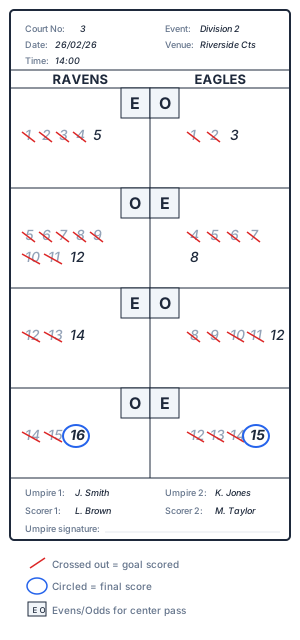
Reading this card:
- Each quarter section shows handwritten numbers for each team — these are the running score totals, with previous numbers crossed out as new goals are scored
- The **E** and **O** boxes between the teams show which team is Evens and which is Odds for that quarter — these may swap between quarters
- At the end of each quarter, the current score for each team is the last uncrossed number
- The final score is circled at the end of the fourth quarter
- Scores carry forward between quarters — quarter 2 picks up where quarter 1 left off
[Download the free Scorekeeper Quick Reference & Tally Card PDF](/downloads/scorekeeper-quick-reference/) — scoring rules on one side and a blank tally card on the other. Print double-sided for a single courtside sheet.
## Paper vs Digital Scorecards
Paper scorecards are still widely used in community and junior netball. They work well but rely on the scorer keeping up with fast-paced play and avoiding mistakes that are difficult to correct on paper.
Digital scoring tools handle the calculations automatically. The running total updates instantly, center passes are tracked without manual counting, and the final scorecard is generated without any adding up.
## Try Digital Scoring
[Netball Scorer Pro](https://app.netballscorerpro.co.uk/) produces a complete digital scorecard for every game. It tracks goals, calculates center passes automatically using either Simple or Official INF rules, and generates a printable scorecard at full time. No paper, no adding up, no mistakes. It works offline on any device — just open it in your browser.
---
### How to Score a Netball Game
URL: https://www.netballscorerpro.co.uk/guides/how-to-score-a-netball-game/
Published: 2026-01-31
Tags: scoring, beginner, guide
Description: Step-by-step guide to scoring a netball game. Perfect for parents and first-time scorers — covers setup, recording goals, center passes, and producing a scorecard.
## What Does a Netball Scorer Do?
The scorer (also called the scorekeeper) is responsible for keeping an accurate record of goals scored by each team throughout the match. This includes tracking quarter-by-quarter scores, the running total, and which team takes each center pass. New to the sport? Read our [introduction to netball](/guides/what-is-netball/) or the [complete rules guide](/guides/netball-rules-complete-guide/) first.
## Setting Up Before the Game
Before the first whistle, you need a few pieces of information:
- **Team names** - confirm with the umpires or team captains
- **Quarter length** - standard is 15 minutes, but junior games may use 10 or 12 minutes
- **Which team takes the first center pass** - decided by coin toss or agreement between captains
- **Venue and date** - for the official record
## During Each Quarter
As goals are scored, record:
1. **Which team scored** - add one point to their tally
2. **The running score** - keep a cumulative total for each team
3. **Center pass allocation** - center passes alternate between teams regardless of which team scores
### Understanding Center Passes
Netball uses an "odds and evens" system for center passes:
- One team is designated "evens" and the other "odds"
- After each goal, add both teams' scores together
- If the total is **even**, the "evens" team takes center pass
- If the total is **odd**, the "odds" team takes center pass
This system ensures fair distribution of center passes throughout the game.
## Between Quarters
At each quarter break, record the quarter score for both teams. Under official INF rules, the odds/evens designations may change at the break depending on whether the quarter ended with a goal or with the ball in play.
## After the Game
Once the final whistle blows, tally up the final scores and confirm with the umpires. A complete scorecard should show:
- Quarter-by-quarter scores for both teams
- Final scores
- Date, venue, and any player awards
## Using Netball Scorer Pro
[Netball Scorer Pro](https://app.netballscorerpro.co.uk/) automates all of this. It tracks scores, calculates center passes automatically, manages the quarter timer, and generates a printable scorecard at the end of the game. It works offline on any device - just open it in your browser and tap "Add to Home Screen".
If you prefer paper, download the free [Scorekeeper Quick Reference & Tally Card](/downloads/scorekeeper-quick-reference/) — a two-page printable PDF with scoring rules on one side and a blank tally card on the other.
---
### Netball Center Pass Rules Explained
URL: https://www.netballscorerpro.co.uk/guides/netball-center-pass-rules-explained/
Published: 2026-01-31
Tags: rules, center-pass, guide
Description: Understand how center passes work in netball, including the odds and evens system, simple rules, and official INF rules for quarter breaks.
## What Is a Center Pass?
A center pass is how play restarts after every goal in netball. It is taken from the center circle by one of the two Centers (C). Knowing which team takes the center pass is a key part of scorekeeping.
The fundamental rule is straightforward: **center passes alternate between teams throughout the match, regardless of which team scores.** The first center pass is decided by coin toss.
## The Odds and Evens System
At the start of the game, one team is designated "evens" and the other "odds". This is determined by which team takes the first center pass — the team with the first center pass takes pass number 1 (odd), making them the "odds" team.
Because center passes alternate, the combined score of both teams tells you the center pass number. This lets you verify which team's turn it is:
| Combined Score | Who Takes Center Pass |
| --------------------------- | --------------------- |
| Even number (0, 2, 4, 6...) | The "evens" team |
| Odd number (1, 3, 5, 7...) | The "odds" team |
### Example
- Score is 3-2 (combined = 5, odd) → odds team gets center pass
- A goal is scored, making it 4-2 (combined = 6, even) → evens team gets center pass
For a detailed breakdown of how this tracking system works, see our [odds and evens blog post](/blog/netball-odds-and-evens-system-explained/).
## Simple Rules vs Official INF Rules
There are two common approaches to handling quarter breaks:
### Simple Rules
At every quarter break, the odds and evens designations **swap**. This is the easier system and is widely used in community and junior netball.
### Official INF Rules
At quarter breaks, the rule is: **"If in play, change the way."**
- If the quarter ended with the ball **in play** (e.g., time ran out during general play), the designations **swap**
- If the quarter ended with a **goal** being scored, the designations **stay the same**
This rule exists because a goal already triggers a center pass change in the alternation, so swapping again would effectively undo it.
## Why It Matters
Getting center passes right matters because:
- It determines which team gets possession after every goal
- Incorrect allocation gives one team an unfair advantage
- Umpires and officials rely on the scorer to track this accurately
For the full rules of netball including all other rules beyond center passes, see our [complete rules guide](/guides/netball-rules-complete-guide/).
## Let the App Handle It
[Netball Scorer Pro](https://app.netballscorerpro.co.uk/) calculates center passes automatically using either Simple or Official INF rules. You choose the rule set during game setup, and the app handles the rest — including quarter break transitions.
---
## Blog Posts
### How Scoring Works in Netball
URL: https://www.netballscorerpro.co.uk/blog/how-scoring-works-in-netball/
Published: 2026-03-06
Tags: rules, scoring, beginners, netball education
Description: Learn how goals are scored in netball, which positions can shoot, where they must stand, and how the scoring system works from start to full time.
If you are new to netball — whether as a player, parent, or scorer — understanding how goals are scored is the starting point. Netball's scoring rules are straightforward, but there are a few details that catch people out.
## How Do You Score a Goal in Netball?
A goal is scored when the ball passes completely through the ring (hoop) from above. The ring sits at the top of a 3.05-metre (10-foot) goalpost at each end of the court.
Unlike basketball, there are no two-point or three-point shots. **Every goal is worth one point.**
## Who Can Score?
Only **two positions** on each team are allowed to shoot:
- **Goal Shooter (GS)** — the primary shooter, usually positioned closest to the post
- **Goal Attack (GA)** — supports the attack and can also shoot
No other position is allowed to score. If a Centre, Wing Attack, or any defensive player somehow got the ball through the ring, it would not count.
## Where Must You Stand to Shoot?
The shooter must be completely inside the **goal circle** (also called the shooting circle or the D) when they release the ball. The goal circle is a semicircle with a 4.9-metre radius around the goalpost.
If any part of the shooter's foot is on or outside the circle line when they shoot, the goal does not count and a free pass is awarded to the other team.
## What Happens After a Goal?
After a goal is scored:
1. Play restarts with a **center pass** from the centre circle
2. Center passes **alternate between teams** throughout the match, regardless of which team scores
3. The scorer records the goal and updates the running total
This alternating possession rule is what makes [center pass tracking](/guides/netball-center-pass-rules-explained/) important — and why many scorers use the odds and evens system to keep track.
## How Long Is a Match?
A standard netball match is played in **four quarters**. Quarter lengths vary by level:
- **10 minutes** — common for junior and school matches
- **12 minutes** — used in many club and league games
- **15 minutes** — standard for senior and international matches
There are short breaks between quarters (typically 2–3 minutes) and a longer half-time interval. The team with the most goals at the end of the fourth quarter wins.
## What Happens If the Score Is Level?
In most league and friendly matches, a draw is a valid result. In knockout or tournament matches where a winner is needed, **extra time** is usually played — typically two additional periods of 7 minutes each. If scores are still level, some competitions use specific tiebreak rules.
## How Is the Score Recorded?
The match scorer keeps a running tally of goals for both teams throughout the game. This includes:
- A **running total** that updates after every goal
- **Quarter scores** recorded at the end of each period
- The **final score** at full time
This can be done on a [paper tally card](/guides/how-to-use-a-netball-scorecard/) or with a digital tool like [Netball Scorer Pro](https://app.netballscorerpro.co.uk/), which tracks everything automatically and produces a printable scorecard at the end. Spectators can follow along too — the [live scoreboard](/blog/live-scoreboard-for-spectators/) mirrors the score on a TV or second screen in real time.
## Quick Summary
| Rule | Detail |
| --------------- | --------------------------------------- |
| Points per goal | 1 |
| Who can shoot | Goal Shooter (GS) and Goal Attack (GA) |
| Where from | Inside the goal circle only |
| After a goal | Center passes alternate between teams |
| Match length | 4 quarters (10, 12, or 15 minutes each) |
| Winner | Team with the most goals at full time |
For a full breakdown of all rules including footwork, contact, and penalties, see our [complete netball rules guide](/guides/netball-rules-complete-guide/).
---
### Netball Odds and Evens System Explained
URL: https://www.netballscorerpro.co.uk/blog/netball-odds-and-evens-system-explained/
Published: 2026-03-06
Tags: rules, center pass, scoring tips, odds and evens
Description: Learn how the odds and evens system works for tracking center passes in netball, including first and second phase passes and what happens at quarter breaks.
If you have ever been told to track center passes using "odds and evens" and wondered what that actually means, this post breaks it down simply.
## What Is the Odds and Evens System?
The odds and evens system is a method scorers use to track which team should take each center pass during a netball match. It works by assigning each team to either "odd" or "even" numbered center passes for the duration of the game.
Here is the key rule: **center passes alternate between teams throughout the match, regardless of which team scores.** The odds and evens system gives you a quick way to verify the correct team is taking each pass.
## How It Works
At the start of the match, a coin toss determines which team takes the first center pass. Let's say **Team A** wins the toss and starts.
- Team A takes center pass 1 → this is an **odd** pass, so Team A is the "odds" team
- Team B takes center pass 2 → this is an **even** pass, so Team B is the "evens" team
- Team A takes center pass 3 → odd pass, Team A's turn
- Team B takes center pass 4 → even pass, Team B's turn
- And so on through the match
Because center passes strictly alternate, Team A will always take the **odd-numbered** passes (1st, 3rd, 5th, 7th...) and Team B will always take the **even-numbered** ones (2nd, 4th, 6th, 8th...).
This pattern holds for the entire match. If it ever breaks, something has gone wrong and you should check with the umpire.
## Why Is This Useful?
During a fast-paced game, it is easy to lose track of whose center pass it should be. The odds and evens system gives you a cross-check: if you know the next pass is number 12, and even passes belong to Team B, you can confirm Team B should be taking it.
You can also verify using the combined score. After every goal, both teams' scores added together tells you the center pass number (since every goal follows a center pass). If the combined score is even, the next pass is even. If odd, the next pass is odd.
## What Are First and Second Phase Passes?
You might hear the terms **first phase** and **second phase** center pass. These refer to what happens at quarter breaks:
- A **first phase center pass** is the center pass that was due when the quarter ended. Since center passes alternate, whichever team's turn it is simply takes the first center pass of the new quarter. Under simple rules, this is straightforward — the alternation continues as normal.
- A **second phase center pass** comes into play under **Official INF rules**. The INF rule states: _"if in play, change the way."_ This means if a center pass was already in play (the ball had been released) when the quarter ended, the odds/evens designations swap for the next quarter. If the pass had not yet been taken, it carries over unchanged.
For most school, club, and league matches, the simple rule is used — center passes just alternate and that is it. The INF rule mainly applies at higher levels of competition.
## A Worked Example
Here is a short example to show odds and evens in action:
| Pass Number | Team | Type | What Happened |
| ----------- | ------ | ---- | ------------------------------------- |
| 1 | Team A | Odd | Team A starts the match |
| 2 | Team B | Even | Alternates to Team B |
| 3 | Team A | Odd | Alternates to Team A |
| 4 | Team B | Even | Alternates to Team B |
| 5 | Team A | Odd | Quarter break — alternation continues |
Notice that Team A always takes odd passes and Team B always takes even passes. The pattern never changes, regardless of which team scored each goal. If this pattern ever breaks, something has gone wrong and you should check with the umpire.
## Do You Need to Track This Manually?
You can track odds and evens on a paper tally card, but it is one of the trickiest parts of scoring to get right — especially across quarter breaks.
[Netball Scorer Pro](https://app.netballscorerpro.co.uk/) calculates center passes automatically using either simple rules or official INF rules. It tracks the pass number, which team should take it, and handles quarter breaks for you. One less thing to worry about courtside.
## Further Reading
- [Center Pass Rules Explained](/guides/netball-center-pass-rules-explained/) — a broader guide covering all center pass rules
- [Netball Rules: A Complete Guide](/guides/netball-rules-complete-guide/) — every rule in the game explained
- [How to Score a Netball Game](/guides/how-to-score-a-netball-game/) — step-by-step scoring guide
- [How to Use a Netball Tally Score Card](/guides/how-to-use-a-netball-scorecard/) — using a paper score sheet
---
### New Feature: Live Scoreboard for Spectators
URL: https://www.netballscorerpro.co.uk/blog/live-scoreboard-for-spectators/
Published: 2026-03-05
Tags: announcement, feature, scoreboard
Description: Netball Scorer Pro now includes a full-screen live scoreboard you can display on a TV or monitor so spectators can follow the game in real time.
Netball Scorer Pro now has a **live scoreboard** — a full-screen, read-only display designed to be shown on a TV, monitor, or second device so spectators can follow the score without crowding around the scorer's table.
## How It Works
While you [score a game](/guides/how-to-score-a-netball-game/) in one browser tab, the scoreboard runs in a second tab. Every time you record a goal, start or pause the timer, or advance to the next quarter, the scoreboard updates instantly.
There is nothing to configure — no accounts, no pairing codes, no extra setup. Both tabs just need to be open in the same browser and they stay in sync automatically.
## What the Scoreboard Shows
The display is deliberately simple and large enough to read from across a hall:
- **Team names** and **live scores** in large text
- **Current quarter** (or "Full Time" when the game ends)
- **Countdown timer** showing minutes and seconds remaining
The scoreboard pairs naturally with the rest of the workflow — read [the role of a netball scorer](/guides/the-role-of-a-netball-scorer/) for a full picture of what the official is tracking on the bench.
It looks good whether it is on a widescreen TV, a tablet propped up on a table, or a phone held up for a small group.
## How to Use It
1. Open [Netball Scorer Pro](https://app.netballscorerpro.co.uk/) in your browser and start or resume a game
2. Tap the **Scoreboard** button (available from the home screen or during a game)
3. A new tab opens with the live scoreboard display
4. Drag that tab to your TV, projector, or second screen
The scoreboard works in any modern browser — Chrome, Firefox, Edge, and Safari all support it.
## One Thing to Note
The live scoreboard is available when using the app **in your web browser**. If you have installed the app to your home screen, the scoreboard button is hidden because installed apps cannot open new browser tabs. If you need the scoreboard, just open the app via its URL in your browser instead.
## Try It Out
Open [Netball Scorer Pro](https://app.netballscorerpro.co.uk/) in your browser and give it a go at your next game. New to the app? The [getting started guide](/blog/getting-started-with-digital-netball-scoring/) walks through your first match in a few minutes.
---
### Netball Positions: All 7 Roles on Court
URL: https://www.netballscorerpro.co.uk/blog/netball-positions-explained/
Published: 2026-02-23
Tags: positions, beginners, rules, netball education
Description: Learn all 7 netball positions, where each player can go on court, and which positions can score. A complete beginner's guide with diagrams and tips.
New to netball? Confused about why some players wear bibs with different letters? Wondering why only certain players are allowed near the goal?
You're not alone! Netball's position system can seem confusing at first, but once you understand the basics, it all makes perfect sense.
## The Court: Understanding the Three Zones
Before we talk about positions, let's understand the netball court. For full measurements, a detailed diagram, and an [animated video walkthrough](/guides/netball-court-layout-and-dimensions/), see our [netball court guide](/guides/netball-court-layout-and-dimensions/). The court is divided into **three equal sections**:
1. **Defending Third** (your goal end)
2. **Center Third** (middle section)
3. **Attacking Third** (opponent's goal end)
Each third also has special areas:
- **Goal Circles** - Semi-circular areas at each end where goals are scored
- **Center Circle** - Small circle in the center third where play restarts after goals
**Key Rule:** Each player position is only allowed in certain zones. They wear bibs with abbreviations so everyone knows who can go where.
---
## The Seven Positions: Who They Are and Where They Play
Netball teams have **7 players on court** (from a squad of up to 12). Here's each position explained simply:
### Goal Shooter (GS)
**Where they play:** Attacking third and goal circle only
**Can they score?** **YES** - This is their main job!
**What they do:**
- Score goals from inside the goal circle
- Position themselves to receive passes
- Work closely with the Goal Attack
- Need excellent shooting accuracy
**Think of them as:** The finisher. Their job is to put the ball through the hoop.
---
### Goal Attack (GA)
**Where they play:** Attacking third, center third, and goal circle
**Can they score?** **YES** - Second scoring position!
**What they do:**
- Score goals from inside the goal circle
- Feed the ball to the Goal Shooter
- Link up play between center and shooting areas
- More mobile than GS - covers more court
**Think of them as:** The versatile attacker. They score AND help get the ball forward.
---
### Wing Attack (WA)
**Where they play:** Attacking third and center third (NOT goal circle)
**Can they score?** **NO**
**What they do:**
- Feed accurate passes to GS and GA
- Create space and opportunities for shooters
- Work with Center to move ball up court
- Fast and agile position
**Think of them as:** The playmaker. They set up the scorers but can't shoot themselves.
**Common beginner mistake:** WA players forgetting they can't enter the goal circle!
---
### Center (C)
**Where they play:** ENTIRE court EXCEPT both goal circles
**Can they score?** **NO**
**What they do:**
- Link defence and attack
- Take center passes after goals
- Cover the most ground
- Both attack and defend
- Need excellent fitness
**Think of them as:** The connector. They're everywhere except the scoring zones.
**Why they're special:** Center is the only position allowed in both attacking and defending thirds (but not the goal circles).
---
### Wing Defence (WD)
**Where they play:** Defending third and center third (NOT goal circle)
**Can they score?** **NO**
**What they do:**
- Mark the Wing Attack
- Intercept passes heading to attackers
- Win the ball back
- Feed the ball to defenders
**Think of them as:** The interceptor. They disrupt the opposition's attack.
---
### Goal Defence (GD)
**Where they play:** Defending third, center third, and goal circle
**Can they score?** **NO**
**What they do:**
- Mark the Goal Attack
- Defend in the goal circle
- Intercept passes to shooters
- Win rebounds from missed shots
- Start attacks from defence
**Think of them as:** The versatile defender. Like GA but on defence.
---
### Goal Keeper (GK)
**Where they play:** Defending third and goal circle only
**Can they score?** **NO**
**What they do:**
- Defend the goal circle
- Mark the Goal Shooter
- Block shots
- Win rebounds
- Need height and reach
**Think of them as:** The last line of defence. They protect the goal.
---
## Quick Position Summary Table
| Position | Attacking Third | Center Third | Defending Third | Goal Circle (Attack) | Goal Circle (Defence) | Can Score? |
| -------- | --------------- | ------------ | --------------- | -------------------- | --------------------- | ---------- |
| **GS** | Yes | No | No | Yes | No | **YES** |
| **GA** | Yes | Yes | No | Yes | No | **YES** |
| **WA** | Yes | Yes | No | No | No | No |
| **C** | Yes | Yes | Yes | No | No | No |
| **WD** | No | Yes | Yes | No | No | No |
| **GD** | No | Yes | Yes | No | Yes | No |
| **GK** | No | No | Yes | No | Yes | No |
---
## Scoring in Netball: The Essential Rules
### Who Can Score?
**Only TWO positions can score goals:**
1. **Goal Shooter (GS)**
2. **Goal Attack (GA)**
That's it! No other positions are allowed to shoot for goal.
### Where Can They Score From?
Goals can ONLY be scored from **inside the goal circle**.
The goal circle is the semi-circular area at each end of the court. If a GS or GA shoots from outside this circle, it doesn't count - even if it goes in!
### How Much is a Goal Worth?
**Every goal = 1 point**
Whether it's scored:
- From right under the post or from the edge of the circle
- In open play or from a penalty/free shot
- By GS or GA
All goals are worth the same: **1 point**
### The Two Ways to Score
**1. Open Play Goals**
- Normal shooting during the game
- Must be from inside goal circle
- Must be by GS or GA
- Worth 1 point
**2. Penalty/Free Shot Goals**
- Awarded when the opposition commits a technical foul
- Taken from inside the goal circle
- Must be by GS or GA
- Worth 1 point if successful
---
## Common Beginner Questions
### "Why can't all players score?"
Netball is about teamwork and strategy. Having only two shooters means:
- Teams must work together to get the ball to the right players
- Players develop specialized skills for their positions
- Games are more tactical and interesting
### "What happens if a player goes in the wrong zone?"
This is called "offside" and results in a free pass to the opposition. The umpire will blow the whistle immediately.
**Common offside situations:**
- WA entering the goal circle
- C entering either goal circle
- GS crossing into the center third
- Any player stepping into a zone they're not allowed in
### "Can positions change during the game?"
Yes! Coaches can substitute players:
- During breaks between quarters (2 minutes or 5 minutes at half-time)
- Sometimes during injury stoppages
Players can switch positions with teammates, but each position on court must always be filled.
### "Which position should I play?"
It depends on your strengths:
**Tall and good at shooting?** → GS or GA
**Fast and accurate passer?** → WA or C
**Super fit and everywhere?** → C
**Great at intercepting?** → WD or GD
**Tall and good at defending?** → GK or GD
**Beginner tip:** Try different positions! Most players experiment before finding their best fit.
---
## Understanding Court Zones Visually
Here's how to think about the court from one team's perspective:
GOAL CIRCLE
GS & GA score here
ATTACKING THIRD
Players: GS, GA, WA, C
CENTER THIRD
C
Players: GA, WA, C, WD, GD
DEFENDING THIRD
Players: GK, GD, WD, C
GOAL CIRCLE
GK & GD defend here
---
## The Goal Circle: The Most Important Zone
The goal circle deserves special attention because **this is the only place where scoring happens**.
**Size:** Semi-circle with a 4.9m (16 ft) radius
**Who can enter:**
- **At attacking end:** GS, GA (your team) + GK, GD (opposition)
- **At defending end:** GK, GD (your team) + GS, GA (opposition)
**Why it matters:**
- Only 2 attacking players (GS, GA) vs 2 defending players (GK, GD)
- All scoring must happen from inside this zone
- Where the most intense battles happen
- Shooters must be accurate under pressure
---
## Tips for New Players
### 1. Learn Your Position's Zones First
Before you worry about skills, memorize where YOUR position can go. Draw it out if needed!
### 2. Watch the Bibs
At the start of a game, look at who's wearing which bib. This tells you:
- Who you're marking (if you're defence)
- Who to pass to (if you're attack)
- Who the shooters are
### 3. Start Simple
When learning:
- Focus on getting in your correct zones
- Make safe, easy passes
- Don't worry about fancy plays yet
### 4. Communication is Key
Call for the ball! Netball players are constantly talking:
- "Here!" when you're free
- "Leave!" if you're covered
- Player names to direct passes
### 5. Watch Higher-Level Games
Watch professional or senior netball and notice:
- How shooters position themselves in the circle
- How centers cover ground
- How defenders anticipate passes
---
## Practice Exercise: Position Quiz
Test yourself! For each scenario, what happens?
**Q1:** GA shoots from just outside the goal circle and it goes in.
**A1:** No goal - must be inside the circle.
**Q2:** WA receives a pass inside the goal circle.
**A2:** Offside! Free pass to opposition.
**Q3:** GS and GA both score - who gets more points?
**A3:** Both get 1 point each - all goals worth the same.
**Q4:** Can GK score if the ball accidentally bounces into their attacking goal circle?
**A4:** No - GK isn't allowed in that third of the court at all!
---
## Remember the Basics
If you're new to netball, remember these fundamentals:
- **Only GS and GA can score**
- **Scoring only happens inside the goal circle**
- **Every goal = 1 point**
- **Each position has specific zones**
- **Going offside = free pass to opposition**
- **7 players on court at all times**
---
## Next Steps
Now you understand positions and scoring! Here's what to learn next:
1. **[The full rules of netball](/guides/netball-rules-complete-guide/)** — ball handling, contact, footwork, penalties, and more
2. **[Types of netball passes](/guides/types-of-netball-passes/)** — chest pass, bounce pass, shoulder pass, and when to use each
3. **[Center pass rules](/guides/netball-center-pass-rules-explained/)** — how play restarts after goals
4. **[Netball drills for training](/guides/netball-drills-for-training/)** — practical exercises to improve your skills
Netball is a fantastic team sport that rewards both individual skill and teamwork. Understanding positions is your first step to enjoying and excelling at the game!
---
**Want to practice?** The best way to learn positions is to play! Join a local club, participate in school netball, or even practice with friends in a park. The more you play, the more natural the positions will become.
**Good luck, and enjoy your netball journey!**
---
_This guide covers basic netball positions and scoring rules suitable for beginners. For official international rules, consult the International Netball Federation (INF) rulebook._
---
_Want to practice scoring during real games? Try [Netball Scorer Pro](https://app.netballscorerpro.co.uk) - a free app for tracking netball scores. Perfect for learning the game as you play! No account needed, works offline._
---
### Getting Started with Digital Netball Scoring
URL: https://www.netballscorerpro.co.uk/blog/getting-started-with-digital-netball-scoring/
Published: 2026-02-01
Tags: guide, getting-started, scoring
Description: Everything you need to know to score your first netball game digitally, from setup to full time. A step-by-step guide for first-time digital scorers.
So you've volunteered to score your first netball game, and someone's just handed you a phone instead of a scorecard and pencil. Don't panic! Digital scoring is actually easier than traditional paper scoring - once you know the basics.
## Why Digital Scoring?
Before we dive into the how-to, let's talk about why more clubs are switching to digital scoring:
- **No more mental math** - The app calculates center passes automatically
- **Never lose a scorecard** - Games are saved digitally
- **Easy corrections** - Spotted a mistake? Just tap to fix it
- **Professional scorecards** - Print or email at full time
- **Works offline** - No wifi at the courts? No problem
## What You'll Need
The beauty of Netball Scorer Pro is that you probably already have everything:
1. **A smartphone or tablet** - iPhone, Android, or any device with a web browser
2. **3 minutes before kickoff** - That's all it takes to set up a game
3. **That's it!** - No account, no download, no hassle
## Your First Game: Step by Step
### Before the Game (2-3 minutes)
**Step 1: Open the App**
Navigate to [app.netballscorerpro.co.uk](https://app.netballscorerpro.co.uk) on your device. Bookmark it for quick access next time!
**Step 2: Tap "New Game"**
You'll see a clean setup screen asking for:
- Team names (not just "Team 1" and "Team 2" - use the actual team names!)
- Quarter length (15 minutes is standard, 12 for juniors)
- Break length (2 minutes standard, 5 for halftime)
- Venue (or tap "Use My Location")
- Date and time (pre-filled with today's date)
- Which team gets first center pass
**Pro tip:** If you're scoring multiple games in a row, take a quick photo of the court schedule on your phone. Makes setup much faster!
### During the Game
The game screen is designed to be simple and uncluttered - you need to watch the match, not your phone!
**Scoring a goal:**
1. A goal goes in
2. Tap the big green **+** button for that team
3. Done!
The app automatically:
- Updates the total score
- Updates the quarter score
- Switches the center pass to the other team
- Shows you which team has next center pass
**If you make a mistake:**
Simply tap the red **-** button to subtract a point. No crossing out, no mess, no confusion.
**Managing the timer:**
- Tap **Start** at the beginning of each quarter
- Tap **Pause** if there's an injury or time-out
- The app will automatically alert you when the quarter ends
### Between Quarters
Here's where digital scoring really shines:
1. The timer counts down your break automatically
2. The app tells you which team gets the center pass next (based on the odd/even rule)
3. When the break ends, you're ready to start the next quarter immediately
**No need to:**
- Calculate odd/even scores in your head
- Write down quarter scores separately
- Worry about totaling up at halftime
### At Full Time
**Step 1: Generate the Scorecard**
Tap the "Scorecard" button to see a professional scorecard showing:
- Final scores
- Quarter-by-quarter breakdown
- Game details (date, time, venue)
- Winner
**Step 2: Save or Share**
- **Print** - Tap print for a physical copy
- **Share** - Use your phone's share function to email or message
- **Save** - The game is automatically saved in the app for your records
## Common First-Timer Questions
**Q: What if I lose internet connection mid-game?**
A: The app works completely offline! Once it's loaded, you don't need internet at all. This is why it's perfect for outdoor courts or venues with poor signal.
**Q: What happens if my phone dies?**
A: This is why many clubs have two scorers - one with the official score, one as backup. If you're the only scorer, charge your phone before the game and consider putting it in battery saver mode.
**Q: How do I know I'm calculating center passes correctly?**
A: You don't have to! The app does it automatically based on official INF rules. Center passes alternate between teams throughout the match. At quarter breaks, it's based on whether the combined score is odd or even.
**Q: Can I edit team names after I've started?**
A: You'll need to start a new game to change team names. Pro tip: Double-check team names before tapping "Start Game"!
**Q: What if both scorers disagree on the score?**
A: Pause the game immediately and check with the umpires. With digital scoring, you can quickly show your screen to verify what you have recorded.
## Tips from Experienced Digital Scorers
**1. Practice Before Game Day**
Spend 10 minutes the night before running through a mock game. Score some imaginary goals, pause the timer, advance quarters. Familiarity breeds confidence.
**2. Communicate with Your Co-Scorer**
If there's another scorer (which there should be!), agree who's the "official" scorer. Compare scores at each quarter break - it takes 5 seconds and catches any discrepancies early.
**3. Position Yourself Well**
Sit where you can see the goals clearly, but close enough to hear the umpires. Having a good view means you'll catch every goal without having to ask "Did that go in?"
**4. Keep Your Phone Charged**
Obvious but critical! Most phones can easily handle a 60-minute game, but if you're scoring multiple games or your battery is older, bring a power bank.
**5. Use the "Save Game" Feature**
Tap "Save" at halftime and at full time. Takes one second, gives you peace of mind.
**6. Don't Overthink It**
The app is designed to be intuitive. If you can send a text message, you can score a netball game digitally.
## Installing as an App (Optional but Recommended)
Want even faster access? Install Netball Scorer Pro on your home screen:
**On iPhone:**
1. Open the app in Safari
2. Tap the Share button
3. Tap "Add to Home Screen"
4. Tap "Add"
**On Android:**
1. Open the app in Chrome
2. Tap the three dots menu
3. Tap "Add to Home Screen"
4. Tap "Add"
Now it appears like a regular app on your phone and works even faster offline!
## Your First Game Checklist
- [ ] Open app.netballscorerpro.co.uk
- [ ] Tap "New Game"
- [ ] Enter both team names correctly
- [ ] Set quarter length (15 min standard)
- [ ] Set break length (2 min standard)
- [ ] Add venue/location
- [ ] Choose which team gets first center pass
- [ ] Check phone is charged
- [ ] Position yourself with good view of goals
- [ ] Tap "Start Game"
- [ ] Tap "Start" timer at kickoff
- [ ] Score goals with + button
- [ ] Check score with co-scorer at each break
- [ ] Save game at halftime and full time
- [ ] Generate scorecard at full time
## Ready to Score?
The first game is always the most nerve-wracking, but by quarter 2 you'll wonder why anyone still uses paper scorecards. Digital scoring is faster, more accurate, and way less stressful.
Remember: every experienced scorer was once a first-timer. You've got this!
If you're completely new to the sport, our guide on [what is netball](/guides/what-is-netball/) covers the basics, and our [netball rules guide](/guides/netball-rules-complete-guide/) explains everything you'll see during a game. For context on why we built the app in the first place, see the [welcome post](/blog/welcome-to-netball-scorer-pro/) — and if you're scoring at a venue with a spare screen, the [live scoreboard for spectators](/blog/live-scoreboard-for-spectators/) is a nice touch for parents and supporters.
**Happy scoring!**
---
_Netball Scorer Pro is a free, offline-capable PWA for netball scoring. No account needed, no ads, no subscriptions. [Start scoring today →](https://app.netballscorerpro.co.uk)_
---
### Welcome to Netball Scorer Pro
URL: https://www.netballscorerpro.co.uk/blog/welcome-to-netball-scorer-pro/
Published: 2026-01-31
Tags: announcement, launch
Description: Introducing Netball Scorer Pro - a free, offline-capable web app for scoring netball games with automatic center pass tracking.
We are excited to introduce **Netball Scorer Pro**, a free web app designed to make scoring netball games simple, accurate, and hassle-free.
## Why We Built It
Scoring a netball game involves more than just tallying goals. You need to track quarter scores, manage the game timer, calculate centre passes using the [odds and evens system](/blog/netball-odds-and-evens-system-explained/), and produce a [scorecard](/guides/how-to-use-a-netball-scorecard/) at the end. Pen and paper works, but it is easy to make mistakes — especially with [centre-pass calculations](/guides/netball-center-pass-rules-explained/).
Netball Scorer Pro handles all of this automatically. Just enter the team names, choose your quarter length, and start scoring.
## Key Features
- **Live scoring** with quarter-by-quarter tracking
- **Automatic center pass calculation** using Simple or Official INF rules
- **Configurable timer** with quarter and break periods
- **Printable scorecards** for your records
- **Works offline** after first visit - no internet needed courtside
- **Free to use** with no account required
## Try It Now
Open [Netball Scorer Pro](https://app.netballscorerpro.co.uk/) in your browser on any device. On mobile, tap "Add to Home Screen" to install it as an app that works offline.
If you are stepping into the scorer's chair for the first time, the [role of a netball scorer](/guides/the-role-of-a-netball-scorer/) and [how to score a netball game](/guides/how-to-score-a-netball-game/) cover everything you need to know — and the new [live scoreboard](/blog/live-scoreboard-for-spectators/) lets spectators follow along in real time.
---